.subtitle{ font-family:Trebuchet MS',Verdana,Arial,Sans-serif; font-size:15px; color: #ca1717; line-height:20px; }

Tuesday, 28 April 2015

NO to 'Beheading', 'Slaying', 'Hacking' & 'Bricking' fellow Human Beings - STOP Xenophobia

Armed with knives, machetes, wrenches, knobkerries, bricks, guns - they mobilised each other in their numbers with the intention to take the lives of their fellow brothers and sisters. They are thirsty for human blood to spill in-front of their homes with no fear of how their children might feel about it. They yearn to see dead bodies lying about, they long to take human life with the least remorse. 

Naume Garusa (www.herald.co.zw)
41 year old Zimbabwean woman Naume Garusa has become the latest victim of the xenophobia attacks in South Africa as her body was found in a bush with her head decapitated. Garusa had been working legally in South Africa since 2002 and was the sole breadwinner for her family. She is said to have been targeted on her way from work. 

What kind of a person would actually slit another human being’s head from end to end till it detaches from the body? When the blood is gutting out and spilling all over the murderer, what kind of feelings are going through his spirit? As Garusa was struggling, grappling for life, groaning as life left her – what kind of sound was the murderer making? Was he laughing? Was he talking? Was he shouting? Was he smiling?

This is not a nightmare, nooooooooo and neither is it a horror movie – it is the act of a demonic people clothed in human skin and it's happening in broad daylight as the world watches in dire disgust. These people are beyond barbaric and sub-headed because of such ghastly, vile, diabolic acts. If you look at the so called stones they are holding – they are big enough to be bricks and it should be called ‘bricking’ of immigrants in the strictest sense.

What crime did Garusa commit?

407 Zimbabweans have returned home with the assistance of the Zimbabwe government following the attacks. A local newspaper The Herald reports that of the 407, 92 are children and 112 are women.  More buses will be returning to Zimbabwe in the next couple of days. Interviewed by Aljazeera, Brenda Mamvenge a returnee from South Africa spoke of how children were being beaten and thrown into storm drains full of water. She decided to leave South Africa but her husband decided to stay behind. Another returnee Climate Muhanga said he had to flee leaving his South African wife and two kids. He felt his wife would be safe because of her nationality – but feared for the children. On Tuesday last week, Muhanga witnessed his cousin Pepukai Museyi being beheaded.

Other governments have also started repatriating their nationals from South Africa which include Malawi and Somalia. 

Sithole being attacked in Johannesburg (www.bbc.co.uk/news)

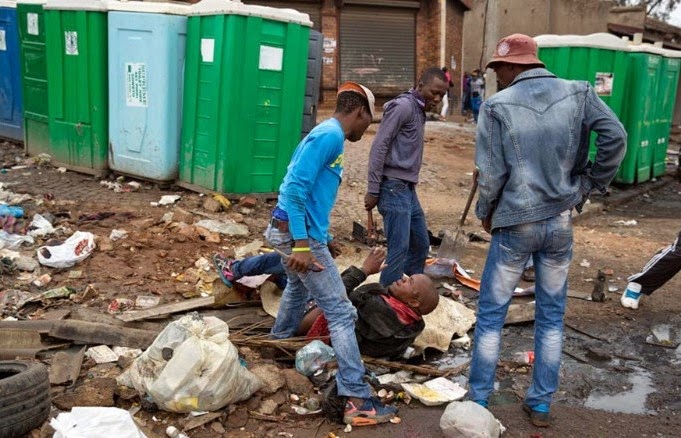
Still on the recent spates of xenophobic attacks, a Mozambican migrant Emmanuel Sithole was stabbed and clubbed by these men in Johannesburg’s Alexandra township. Looking at the murderer’s faces – one can notice the determination to cause some form of grievous body harm. In the picture above and below, members of the community look on and do not attempt to help Sithole.

Sithole being attacked with a wrench (www.bbc.co.uk/news)

Thugs surround Sithole as they continue to assault him (www.bbc.co.uk/news)

The murderous men surround Sithole whom they have brought down to the rubbish-strewn ground. One of them is holding a shovel – Heaven knows for what!! In the eyes of man, Sithole doesn’t stand a chance. The murderers faces depict young men who should be doing much better things with their lives – men who should be aspiring to be the next Southern Africa Development Community president, young men who should channel their energy in studying to become engineers, medical doctors, accountants, businessmen. But alas - what a shame it is for their fate is not less than 15 years in prison for first degree murder.

Sithole being taken to the hospital (www.bbc.co.uk/news)
After the incident, Sithole is lifted into reporters’ car and taken to hospital where paramedics administered CPR but failed to resuscitate him. Photographer James Oatway who managed to witness these unfortunate events described how Sithole stared at him in the car with shock at what had just taken place. These people committing theses killings are not thugs because by the time Sithole died at the hospital, he still had his cellphone and R285 in his pockets, said Oatway. These people are possessed by demons who seek to kill, and for no reason at all.

What crime did Sithole commit?

A 14 year old teenager who was shot dead in the KwaZulu-Natal town of Ntuzuma is one of the victims of these senseless attacks on fellow human beings.

At least seven people have died and thousands displaced in the latest xenophobic attacks. African foreigners have been targeted in the attacks which have also seen immigrants businesses being attacked and looted. The locals attacking African immigrants are doing so for the reasons that they are causing social and economic harm and according to Bloomberg News, police say the attacks began after a group of Durban residents accused a supermarket of replacing its workers with foreigners. Some South Africans have accused immigrants for taking jobs and opportunities away from them.

Zulu King Goodwill Zwelithini who is an influential figure in the Zulu ethnic group has been accused of causing these attacks as he was quoted saying foreigners must 'pack their bags' and leave. South African president Jacob Zuma's son, Edward has also been accused of inciting xenophobia by his comments about foreigners. 

"We need to be aware that as a country, we are sitting on a ticking time bomb of them (foreigners) taking over the country. The reason why I am saying that is because some of the foreigners are working for private security companies where they have been employed for cheap labour. These companies are running away from complying with South African labour laws," said the President's eldest son.

Jacob Zuma denounced these attacks on foreigners and assigned a team of three ministers to end the attacks and strongly condemned the violence but has however refused to call the attacks xenophobic because the attacks 'were not targeted at all nationalities.' Police Minister Nkosinathi Nhleko also echoed the same sentiments as the president, calling the attacks Afrophobia and that they were ideologically driven.

In as much as it is mostly Africans being targeted in these attacks, mainly those from Somalia, the Democratic Republic of Congo, Mozambique, Nigeria, Malawi and Zimbabwe often running shops, stalls and businesses - Pakistani and Indian nationals have also been targeted. These attacks are fueled by a sense of hatred, dislike and fear of foreigners and it's high time the South African government call a spade a spade - this is most Definitely Xenophobia.

Young women looting foreign-owned shops in Soweto - January this year (www.ibtimes.com)

South African police ignoring looting of a foreign-owned shop in White City Soweto - in January (www. timeslive.co.za)

The anti-foreigner violence is reminiscent of the 2008 attacks  which killed 62 people - 21 of which were South African citizens and about 50 000 were displaced from their homes. 

In 2013, a 25 year-old Somali man Abdi Nasir Mahmoud Good was found lying flat in a Port Elizabeth street after being stripped naked, his genitals pelted with rocks, stones smashed over his head all the while receiving kicks in the face. He died due to his injuries. Two Somali brothers were also allegedly hacked to death which led to public outcry and worldwide protests by the Somali diaspora in Cape Town, London and Minneapolis.  Five other Somalis were injured in the violence and almost every Somali-owned business in Port  Elizabeth’s Booysen Park was burned or looted. 

Afrophobia, Europhobia, Americaphobia makes noooooooo difference at all - its all Xenophobia. South African authorities should STOP trying to be clever in their terminology and deal with these inhuman barbaric acts and I surely hope to have seen and heard the last of them this year.

Wednesday, 18 February 2015

Sterilisation - Why it's the most common contraception in the world today

Over 250million women and men worldwide rely on a permanent contraceptive method – female sterilisation or vasectomy – to achieve their intention to limit childbearing; that’s according to a recent United Nations (UN) report. In 2014 the UN reported that for the world as a whole, female sterilisation is the most common method of contraception with more than 200 million women relying on it, representing 19% of women aged 15 to 49 who are married or in a union.

Trends of permanent contraceptive use across the world for women who are married or are in a union are; North America (33%), South America (26%), Asia (26%), Africa (2%); that’s according to United States Aid (USAID 2013).

Sterilisation has become so popular due to the need to limit or stop childbearing especially with couples who are certain they have completed their childbearing. According to the United States Census Bureau’s American Community Survey, 46% of women aged 15-44 were childless in June 2008 compared to 35% of childless women in 1976. The personal freedoms of a childless lifestyle and the ability to focus on their relationships were common motivations underlying the decision to be voluntarily childless. Such personal freedoms included increased autonomy and improved financial positions. The couples could engage in more spontaneous activities because they didn't need a babysitter or to consult with someone else. Women had more time to devote to their careers and hobbies.

Latin America, Asia and parts of North America and Western Europe have shown high and in many cases growing sterilisation prevalence with the largest increases recorded in the Democratic Republic and Brazil. The prevalence rate of female sterilisation is highest (47%) in the Democratic Republic. In Columbia, Costa Rica, El Salvador and Puerto Rico levels range between 30% and 40%, Brazil is over 25%, the Caribbean (26%) and a few countries in other regions, including China (29%) and India (36%) – according to UN 2013.

High resource countries/developed regions have a broad mix and high use of permanent methods as well as in the better resourced countries of developing regions. A 2014 USAID report showed that the United Kingdom (UK) has been one of the few countries where the incidence of sterilisation in men exceeds that in women. Female sterilisation prevalence in the UK is 8% while vasectomy is at 21%. The trend is the same in Canada where female sterilisation prevalence is 11% while vasectomy is at 22%. In the United States however, female sterilisation prevalence is higher – at 24% than vasectomy which is 13%. Vasectomy use alone accounts for almost one third of all modern method use in Canada and one quarter of such use in the UK.

Columbia and Thailand, both relatively wealthy countries but still classified by the UN as “less developed” have implemented longstanding successful programmes to make a broad range of contraceptive methods and services widely known, widely available and equitably accessible. Both countries including Brazil and Mexico have achieved a diversified method mix, with methods of contraceptive use comparable to or exceeding those in countries of Northern America and Western Europe. Permanent method use comprised 42% of all modern method use in Thailand in 1987 according to Chayovan, Kamnuansilpa & Knodel (1988) and 35% of such use in 2006 (UN 2012). In 2010 52% of all modern method use in Columbia consisted of permanent methods (Profamilia 2011). In both countries, female sterilisation is the predominant permanent method.

Sterilisation is however not very common in Africa representing only 2% use on a global perspective. In West Africa, 0% of women have been recorded to be using sterilisation as a family planning method, while in East Africa its 2% and 14% in Southern Africa. This low use of sterilisation is particularly common in low resource countries that in-turn have lower availability and access to permanent methods. USAID accredits this low use on socio-economic and political factors. It states that in the face of competing demands and countervailing factors, such as shift in program and donor focus to the HIV epidemic, political instability and decentralisation of health services, large successful family planning programmes aimed at increasing the knowledge of permanent methods of family planning mainly female sterilisation have fallen over the past 10-15 years. Knowledge of female sterilisation fell from 82% in 1988 to 67% in 2008 among Kenyan women and knowledge of vasectomy dropped from 48% to 38% (KNBS & ICF Macro 2010). Between 2008 and 2009 the female sterilisation prevalence in Kenya was 5% while vasectomy was 0%.

Nigeria and the Democratic Republic of Congo- DRC (which are the most populace countries in the West African region) are among the world’s lowest users of permanent family planning methods. Due to the countries dealing with armed conflict, ethnic strife and humanitarian crises; USAID suggests that a large family size remains ideal in these two countries at more than six children per woman. The prevalence of female sterilisation use in DRC is 0.8% and 0.3% in Nigeria. The prevalence of vasectomy use in both countries is 0%.  In Nigeria, knowledge of female sterilisation is only 44% among married women and 50% among married men. Knowledge of vasectomy is even lower, at 16% and 30% respectively. In Zimbabwe, the female sterilisation prevalence rate between 2010 and 2011 was 1.1% and vasectomy was 0%.

Available evidence indicates that a large subset of women and couples served by family planning programmes in low-resource countries would opt for a permanent method if it were available and accessible, just as women and couples do in higher resourced settings (WHO 2010). Hence a UN 2014 paper suggests that making permanent methods widely available and equitably accessible as a voluntarily chosen method in the family planning programs of low resource countries is not only feasible, cost effective and popular with clients – it is an ethical imperative. This follows the findings that; lower income countries have a high unmet need of their current use of long acting reversible contraceptive methods and short-acting resupply methods.

USAID reports that the demand to limit births now exceeds demand to space births in every region of the world except West and Central Africa, and the average age at which demand to limit exceeds demand to space is falling in many countries, to as low as age 23 or 24. (Van Lith, Yahner & Bakamjian, 2013). Clinical guidelines suggest additional care when counselling people under the age of 30 without children who request sterilisation, due to the possible increased incidence of regret.

In the UK from a legal perspective, only the patient who submits to operation needs to give consent and the operation can be performed without knowledge of the partner.  This has however not been the case in other parts of the world where the man gives consent even without the wife’s knowledge to carry out sterilisation. In some instances health care providers have tricked and coerced women in vulnerable situations into getting sterilised.  

Female sterilisation has not gone without controversy as in November last year, 13 women in India died and dozens more were hospitalised after undergoing sterilisation procedures in the central Indian state of Chhattisgarh. More than 80 women underwent surgery for laparoscopic tubectomies at a free government-run camp. Of these, about 60 fell ill shortly afterwards with officials saying blood poisoning or hemorrhagic shock might have been the cause.  
Some of the women receiving treatment after the mass sterilisation went horribly wrong. (Source: www.theguardian.com)
Despite being an effective method of contraception for those in stable relationships, sterilisation compared to many surgical procedures is still fraught with cultural, religious, psycho-social, psycho-sexual and psychological issues.

Saturday, 15 November 2014

Greatest Woman Of All Time - Mrs. Mutubuki

Affectionately known as ‘mama’ or Mrs. Mutubuki by her former students and colleagues, she has for 32 years challenged the establishment that sought to discriminate and deprive the girl child’s right to education at Fletcher High School (FHS).

Laurentia Mutubuki

Laura House boarding (Source: Ropa Mutubuki)

The founder of Laura House boarding for Fletcher girls in Gweru, Zimbabwe; Laurentia Mutubuki has been described by thousands as the greatest woman of all time.

She joined the school in May 1982 the same year they started enrolling female students. The then headmaster Mr. Chimombe was very positive about taking in female students but the problem came with other headmasters that followed for example Mr. Mhlanga and Mr. Nyanhongo who wanted to return the former Fletcher ‘all boys legacy’ by removing all female students from the school. This was nicknamed the ‘Pangolin Era’ meaning ‘the special students’. Mhlanga cut down the number of classes to only two just to accommodate boys only. Mrs. Mutubuki challenged this decision.

“I fought tooth and nail to make sure that girls continued their education at Fletcher,” she said. “At a point there was only one A’ Level female in the whole school and that was one of my daughters,” Mrs. Mutubuki recalled.

Mrs. Mutubuki was supported by other female teachers such as Mrs. Chigidi and Mrs. Muchibwa. Eventually female students were allowed back to the school, however not without much segregation and harassment from male students. Mrs. Mutubuki's daughter Mukai Henrietta Mutubuki-Kumirai expressed in an interview her experience as an only A' Level female student at that time and how she dealt with the different types of boys at the school. 

“There were some very nice boys who would see you as one of their friends but there were those who would verbally abuse me. I used to ignore those who hailed insults at me and go on with my studies,” said Mukai.

However, she didn’t take it lightly when others groped her. She said, “There was also the aggressive type of boys who felt a girl’s place should be in the kitchen. These boys were hostile ... and I literally beat them up in fist fights, and did not take crap from anybody.”

For Mukai, learning with boys only had its advantages in that it equipped her for the future where she went on to study in a male dominated field and excelled exceptionally. She is now a qualified senior quantity surveyor in the United Arab Emirates. One of the disadvantages was the inability to make and keep female friends.

Fletcher High School was built in 1957 as a boys school and till today only offers boarding facilities for boys. Female students have been day scholars (meaning they have to commute from home to school everyday).

After realising that the head-girl had missed school for a whole week because she couldn't afford the bus fare, Mrs. Mutubuki in 2001 established Laura House boarding (a separate boarding facility for girls). This was the case with a number of other female students, male included. The Mutubuki family had a property and house just next door to their current residence; which was just lying idle and uninhabited. This then became the boarding house premises anchored by the mission statement; 'Empowering the girl child's academic excellence and personality.' "I want to promote the diligence, dignity and success of the girl child,” Mrs. Mutubuki said.

Mrs. Mutubuki (right) with some of the students at Laura House. (Source: Ropa Mutubuki)

In the first year Mrs. Mutubuki accommodated up to 20 A’ Level female students. In the beginning she faced a lot of challenges which included non-availability of furniture such as beds, tables and chairs; cutlery, utensils and transport to take them to and from school. For the whole first year, she didn't charge the students for anything, in-fact she provided for them completely free of charge.

Students in their rooms (Source: Ropa Mutubuki)
“I housed them for free for the whole year. I used my savings to take care of them, feed, pay the bills and transport them to and from school,” said Mrs. Mutubuki. Her intentions were to make sure that the girls could have a place where they could concentrate with their studies and be able to pass their examinations. This was a real commitment for the betterment of the girl child. 

Mrs. Mutubuki felt that it was ethically wrong for her to charge her students whom she taught in school. As a result, some of her teacher friends at Fletcher High for example the late Mrs. Shumba insisted that she charge the students and even helped in setting the boarding fee. However, Mrs. Mutubuki could only agree to a nominal fee which resulted in her not retaining any much profit.

Over the years Laura House has grown to accommodate Forms 1 to 6 with students coming from across Zimbabwe and some with parents who work outside the country. This boarding facility has greatly improved the female students pass rates at Fletcher and has even excelled above their male counterparts. In 2013 for example, the highest A’ Level students were from Laura House with 14 points – meaning they attained 2As and 1B. These were Chidochashe Ncube and Mawonei Mabika. Rumbidzai Chonyera attained 13 points while Honest Mazorodze and Anesu Mwata attained 12 points, Natsai Mushonga, Pamela Mutasa and Rachel Machopo attained 11 points. In year 2012 Shylette Chikadzi got 13 points and Shamaine Mutizira, Alberta Zhou and Pauline Ngwenya achived 10 points. The students have proceeded for their higher education at universities across the world including Russia, China, Poland, South Africa, Namibia and Zimbabwe.

Some of the A' Level Students & Mrs. Mutubuki (Source: Ropa Mutubuki)
With the establishment of Laura House, there has been a marked increase of female students taking up previously male dominated science subjects at A’ Level like Biology, Chemistry, Physics and Mathematics. Laura House has managed to attract the crème de la crème of female students across the country which has had a ripple effect of an improved pass rate for Fletcher.

The House currently has 65 students but has a capacity of up to 80. The students are allowed to attend a church of their choice on the weekends.

Electricity is readily available for the students to study through an inverter. For cooking, the boarding house uses electricity but in the event of power surges, there is a back-up of firewood and gas. There is a borehole at the boarding house and this allows the students access to uninterrupted water supply.

Dining Room. Round hut is for cooking with firewood
Top: Kitchen Bottom: Dining & Study
Mrs. Mutubuki now a retired teacher was a national examiner as she started marking Zimbabwe Junior Certificate Language 2 in the early 1980s and went on to mark A’ Level Shona from the mid 80s. In this light and with her more than 40 years teaching experience, she is in the process of transforming the boarding house into a Girls Academy (boarding school) which will enrol Form 1 to Form 6 female students. Her husband Edias Mutubuki has been instrumental in the growth of the boarding facility by among other things extension of the house, electrification, water supply and food production.

Below is a video by Ropa Mutubuki of the girls on the lighter side.


Saturday, 25 October 2014

Behavioural & Dietary Change - Key to Beating Cancer

The World Health Organisation (WHO) has reported that cancers are among the leading causes of death worldwide, accounting for 8.2million deaths in 2012 which is a rise from 7.6million in 2008.

The most common causes of cancer death are cancers of the Lung (1.59million deaths), Liver (745.000), Stomach (723.000), Colorectal (694.000), Breast (521.000) and Oesophageal (400.000).

WHO says about 30% of cancer deaths are due to the 5 leading behavioural and dietary risks which are; high body mass index, low fruit and vegetable intake, lack of physical activity, tobacco use and alcohol use. Tobacco use is the most important risk factor for cancer, causing 22% of global cancer deaths and about 71% of global lung cancer deaths. It's clearly evident that the risk of cancers can be drastically trimmed down if we change some of our bad habits. Cancer is definitely beatable in this light.

Cancer causing viral infections such as Hepatitis B (HBV), Hepatitis C (HCV) and Human Papilloma Virus (HPV) are responsible for up to 20% of cancer deaths in low- and middle-income countries. Cervical cancer which is caused by HPV is a leading cause of cancer death among women in low-income countries.

 Estimated Cancer Incidence and Mortality – GLOBOCAN 2012

Men Cases
Men Deaths
Women Cases
Women Deaths
World
7 427 000
4 653 000
6 663 000
3 548 000
More Developed regions
3 244 000
1 591 000
2 832 000
1 287 000
Less Developed regions
4 184 000
3 062 000
3 831 000
2 261 000
WHO Africa region (AFRO)
   265 000
   205 000
   381 000
   250 000
WHO Americas region (PAHO)
1 454 000
   677 000
1 429 000
   618 000
WHO East Mediterranean region (EMRO)
   263 000
   191 000
   293 000
   176 000
WHO Europe region (EURO)
1 987 000
1 080 000
1 750 000
   852 000
WHO South-East Asia region (SEARO)
   816 000
   616 000
   908 000
   555 000
WHO Western Pacific region (WPRO)
2 642 000
1 882 000
1 902 000
1 096 000
IARC Membership–24countries
3 706 000
1 900 000
3 354 000
1 570 000
United States of America
   825 000
   342 000
   779 000
   293 000
China
1 823 000
1 429 000
1 243 000
   776 000
India
   477 000
   357 000
   537 000
   326 000
European Union (EU-28)
1 446 000
   715 000
1 211 000
   560 000

More than 60% of the world’s total new annual cases occur in Africa, Asia, Central and South America. These regions account for 70% of the world’s cancer deaths.

Tobacco Use
Source: modifylifestyle.com
“Smoking is by far the most important preventable cause of cancer,” says Cancer Research UK adding that smoking accounts for more than one in four UK cancer deaths and nearly a fifth of all cancer cases. Smoking increases the risk of lung cancer as well as of 14 others including cancers of the larynx (voice box), oesophagus (gullet), mouth and pharynx (throat), bladder, pancreas, kidney, liver, stomach, bowel, cervix, ovary, nose and sinus, breast and some types of leukaemia.

Children are mostly affected by passive smoking because they breathe faster than adults.

Alcohol Use

A 2011 review by Cancer Research UK suggest around 4% cancers are linked to alcohol. High alcohol intake increases the risk of mouth, liver, breast, bowel and throat cancers. In the UK for example, people have adopted a frequent casual drinking culture which in most cases turns to ‘binge drinking’ and is highly risky to one’s health. The National Health Services (NHS) recommends the following; Men should not regularly drink more than 3-4 units of alcohol per day and for women it's no more than 2-3 units. It also recommends that if you've had a heavy drinking session, you must avoid alcohol for 48 hours. One ‘unit’ equals 10ml or 8g or pure alcohol. ‘Regularly’ means drinking this amount everyday or most days of the week.
Source: drinkaware.co.uk
Smoking and drinking together raises the risk of these cancers far more than the effects of either drinking or smoking alone.

Diet
Fruit and Vegetables – Your 5 a day
A study by Cancer Research showed that people who eat the widest range of fruit and vegetables have 22% lower risk of mouth cancer than those with the narrowest range. However these should not be taken as supplements but as real fruit and vegetables. “Fruit and vegetables are a good source of natural fibre and there is strong evidence that high levels of fibre reduce bowel cancer.” Eating plenty of fruit and vegetables can help you maintain a healthy body weight.

Red and Processed Meat
Medical experts have advised to desist from eating lots of red or processed meat because it increases the risk of bowel cancer. The meats contain a red pigment called haem which can irritate or damage the cells in the bowel. Red meat which include all fresh, minced and frozen beef, pork or lamb may also cause pancreatic and stomach cancers. Processed meat includes ham, bacon, salami, sausages, spam, conned beef, pate and tinned meat. A report from Cancer Research suggests around a quarter of bowel cancer cases in men and around one sixth in women are linked to eating red or processed meat.

Consequentially, processed meat is more strongly linked to cancer risk than red meat due to the compounds i.e. nitrites and nitrates; which are used to preserve the meat. There is some evidence that the effects of haem could be countered by chlorophyll, found in green vegetables. It is advised not to take more than 100g of meat a day. White meat is healthier than red meat.

Fish
Eating lots of fish (particularly oily fish like salmon, trout,  mackerel) may lower the risk of bowel cancer.

Fibre rich foods
A review showed that eating 10g of fibre per day can reduce the risk of bowel cancer by around 10%. Examples of food rich in fibre are whole grains cereals and bread, brown rice and pulses. Fibre triggers the production of helpful chemicals and increases the frequency of bowel movements.

Salt
A diet with lots of salt increases one’s risk of stomach cancer by damaging the lining of the stomach and causing inflammation, or by making the stomach lining more sensitive to carcinogens such as nitrates. Countries such as Japan where people eat a lot of salt, pickled and smoked foods have a high rate of stomach cancer. A diet with no more than 6g of salt each day is recommended.

Animal Fats
Eat less animal fats for example butter, cream, cheese.

Cooking Methods
Boiling or braising meat is much healthier than cooking it at very high temperatures like barbeque or grilling which can cause the meat to produce harmful chemicals such as heterocyclic amines and polycyclic aromatic hydrocarbons many of which cause cancer. It is better not to fry foods and if you use fats in cooking, choose vegetable oils or olive oil; not lard or butter.

High Body Mass Index
According to the American Cancer Society (ACS), overweight or obese people have an increased risk of bowel and pancreatic cancers and this could be because they tend to have higher insulin levels. Obese means being more than 25% overweight. The ACS goes on to say having too much belly fat (that is a larger waistline) regardless of body weight, is linked with an increased risk of colon and rectal cancer, and is probably linked to a higher risk of cancers of the pancreas, endometrium, and breast cancer in women past menopause. Obesity may also lead to oesophageal, kidney, and gallbladder cancers.

It’s essential to frequently check one’s body mass index to make sure you maintain it at the right level. Exercise and frequent physical activities will help you maintain a healthy body weight. 

Viruses
Viruses can help to cause some cancers. These cancers and viruses are linked;
Cancers
Virus
Cervical cancer and other cancers of the genital and anal area
HPV
Primary liver cancer
HBV, HCV
Lymphomas
Epstein-Barr
T cell leukaemia in adults
Human T cell leukaemia
Oropharyngeal cancer and non menoloma skin cancers in some people
HPV

However, many people can be infected with a cancer causing virus, and never get cancer.

Genetic Predisposition
Hereditary cancers are primarily caused by an inherited genetic defect. According to Macmillan Cancer Support, it’s thought that about 5-10% of cases may be linked to inherited genes. “Scientists have discovered cancer susceptibility genes for some of the more common cancers that can run in families such as breast, bowel, ovary and womb. There are other cancers such as prostate, pancreatic and testicular which may run in families, but specific cancer susceptibility genes for these cancers haven’t been identified yet”, they said.

Age
Age is the single biggest risk factor for cancer. The older you are the more likely you are to develop cancer because the longer we live, the more cancer causing faults we accumulate in our DNA. Nearly two thirds of all cases of cancer diagnosed in the UK occur in people aged over 65 years. Macmillan Cancer Support reported that age is the strongest risk factor for prostate cancer citing that men under 50 years of age were at a lesser risk. Similarly, the risk factor of developing breast cancer also increases with age.

Ultra-violet (UV) Radiation
The American Cancer Society says skin cancer is the most common of all cancers in the United States of America (USA) accounting for nearly half of all cancers in the US. The main cause is exposure to ultra-violet radiation from the sun as well as sunlamps and sun-beds (tanning beds and booths). Most modern Ultra Violet (UV) tanning beds emit more than 95% UVA rays. UV light damages the DNA of our skin cells and can cause skin cancer. So this is food for thought for you the next time you decide on getting that 'trendy tan'. It's not a fashion or beauty statement but a skin damage statement  and can increase the risk of skin cancer. Next time you go for that long awaited summer holiday, make sure you protect yourself from the sun by wearing a hat, sunglasses, putting on some sun-screen and staying in the shade. A trip to the tanning booth is not a good idea after all.

Friday, 19 September 2014

The Bagpipes Have Spoken ... it's NO to Scottish Independence


Scots playing bagpipes at a parade (Source : spoonandchair.wordpress.com)

After months of intense campaigning, heated debates, clashing and agreeing of diverse points and erratic speculation on the Scottish Referendum, the Scots finally went to the polls yesterday and a resounding No vote to independence is the result. 53.3% voted to remain a part of the United Kingdom while 44.7% voted for independence.

A paltry 4 council areas voted Yes which were Dundee, West Dunbartonshire, Glasgow and North Lanarkshire. 28 council areas voted No, bringing a resounding victory to the “Better Together” camp.
 
At a press conference this morning “Better Together” leader Alistair Darling still promised to work towards change in Scotland saying 'No vote doesn't mean No change'. Yes campaign leader Alex Salmond accepted Scotland's voice and urged Scots to move on together. Back in Downing Street Prime Minister David Cameron affirmed his promise of further devolution of powers to Scotland in what some have described as a quasi Devo Max (Maximum Devolution), which means getting power over everything apart from defence and foreign affairs. There is a huge sentiment that Holyrood might not gain control over oil take or corporation tax.

In Aberdeenshire which is Salmond’s council area, 40% voted Yes while in Edinburgh which is Darling’s, 61% voted No.

It was an 84% voter turnout as 3.6million of the total 4.2million registered voters cast their ballots. This voter turnout has been described as a record high in the UK. The No victory suggests that perhaps independence was not necessarily the necessary way to go, in trying to gain more powers for Scotland.

 Below is a breakdown of how the 32 council areas voted.

Yes Votes
Dundee - 57%
W. Dunbartonshire – 54%
Glasgow – 53%
N. Lanarkshire – 51%


                               No Votes

Edinburgh - 61%
E. Dunbartonshire - 61%
Fife - 55%
E. Lothian - 62%
S. Lanarkshire - 55%
E. Renfrewshire - 63%
Aberdeenshire - 60%
Eileanan Siar - 53%
Highland - 53%
Inverclyde - 51%
Aberdeen - 59%
Midlothian - 56%
W. Lothian - 55%
Moray - 58%
Renfrewshire - 53%
N. Ayrshire - 51%
Falkirk - 53%
Orkney Islands - 67%
Angus - 56%
Perth &Kincross - 60%
Argyll & Bute - 59%
Scottish Borders - 67%
Clackmannanshire - 54%
Shetland Islands - 64%
Dumfries & Galloway - 66%
S. Ayrshire - 58%
East Ayrshire - 53%
Stirling - 60%

After the results were announced the British Pound strengthened and shares rose. Royal Bank of Scotland which had last week indicated that in the event of an Independent Scotland, its headquarters would move to England, its shares today went up by 4 percent which is nearly a two-year high against the Euro. This suggests business confidence in a united United Kingdom. 

In the run-up to next year’s general elections Westminster must be seen owning up to its promise for devolution of powers for Scotland in-order for most Scots to vote in favour of conservative Members of Parliament.